
Most stressful moments do not begin with a dramatic event. They often begin with a small decision.
- Do you keep walking or change direction?
- Do you stay polite or create distance?
- Do you ignore the uncomfortable feeling or trust it?
- Do you wait for more proof or take a calm step sooner?
- Do you freeze, hesitate, or move with intention?
That first decision matters. For many women, decision-making under pressure is not about knowing every possible response. It is about learning how to recognize what is happening early enough to choose the next best action. When pressure rises, clarity can disappear quickly. That is why confidence, awareness, and preparedness need to be built before the moment happens.
For women in Las Vegas, Summerlin, Spring Valley, Henderson, North Las Vegas, and throughout Southern Nevada, everyday life can include crowded parking lots, busy restaurants, work events, travel days, public spaces, and unfamiliar environments. Most of these moments are ordinary. Some may become uncomfortable. A few may require clear action.
Wendy Jay confidence under pressure training is designed to help women build practical awareness, emotional steadiness, and real-world decision-making skills without fear-based messaging. The goal is not to make women anxious. The goal is to help them feel more capable, prepared, and confident before pressure appears.
What Is Decision-Making Under Pressure?
Decision-making under pressure is the ability to choose a clear next step when stress, uncertainty, emotion, or urgency are present. It is not about making a perfect decision. It is about making a useful decision when hesitation could cost time, distance, or control.
Under pressure, many people do not think the way they expect to think. Stress can narrow attention, speed up thoughts, make emotions louder, and create a feeling of uncertainty. A woman may know what she wants to do, but still hesitate because the moment feels uncomfortable or unclear. This is why training matters. The first decision becomes easier when a woman has already practiced how to observe, assess, and act.
Strong decision-making may include:
- Recognizing that something has changed
- Creating space when discomfort appears
- Using a clear voice
- Moving toward a safer area
- Leaving before a situation escalates
- Asking for help sooner
- Trusting instincts before needing perfect proof
- Choosing action instead of freezing
These decisions may sound simple, but they can feel difficult without preparation. Preparedness psychology helps explain why.
How Preparedness Psychology Shapes Response
Preparedness psychology focuses on how the mind responds before, during, and after stressful moments. It looks at awareness, instinct, hesitation, emotion, stress response, and decision-making patterns. For many women, the issue is not that they are unaware. It is that they notice something and then question themselves.
These thoughts are common, especially for women who have been conditioned to prioritize politeness or avoid conflict. The problem is that stress can make hesitation stronger. Decision-making under pressure improves when women understand these patterns. Instead of blaming themselves for freezing or second-guessing, they can learn how hesitation works and train a better response.
This is a key part of real-world readiness. Preparedness is not only about physical skill. It is also about understanding what happens internally when stress shows up.
Why the First Decision Matters Most
The first decision often sets the tone for everything that follows. If a woman notices something uncomfortable and acts early, she may still have many options. She can change direction, go back inside, call someone, move closer to people, create distance, or leave. These decisions are often quiet and low-risk.
If she waits too long, her options may narrow. That is why the first decision matters so much. It does not need to be dramatic. It only needs to be timely.
For example, a woman leaving a restaurant in Las Vegas or anywhere for that matter, may notice someone lingering near her vehicle. Her first decision might be to pause at the doorway and observe. It might be to ask an employee to walk with her. It might be to return inside and wait. These are simple decisions, but they can create safety, space, and confidence.
Confidence under pressure grows when women learn that early action is not overreaction. It is often the calmest and most practical response.
Confidence Under Pressure Is Built in Advance
Many women hope they will know what to do if something happens. Hope can feel comforting, but it is not a plan. Confidence under pressure is built before the moment happens. It grows through awareness, repetition, education, and permission to trust yourself.
Before pressure appears, women can practice noticing exits, reducing distractions, observing behavior, creating space, and using clear language. These habits make decision-making easier because the mind has a framework to follow.
A woman does not need to become aggressive to become confident. She does not need to become fearless. She needs practical skills, emotional clarity, and a plan for what to do when something feels off.
This is where Wendy Jay Training and confidence under pressure becomes valuable. It helps women connect awareness to action, so they do not get stuck in the gap between noticing and deciding.
Emotional Composure Under Pressure
Emotional composure under pressure is the ability to stay connected to your judgment when stress rises. It does not mean ignoring emotions. It means learning how to keep emotion from making every decision for you.
In stressful moments, the body can react quickly. Breathing may change. The heart may race. Thoughts may become scattered. For some women, this creates urgency. For others, it creates freezing or hesitation. Composure helps create a pause.
That pause might be one breath. One step back. One look around. One clear sentence. One decision to leave. This is not passive. It is powerful. When women build emotional composure under pressure, they are better able to respond instead of only reacting. They can ask, “What is happening, what are my options, and what is my next best decision?” That internal clarity is central to preparedness.
Why Women Often Freeze or Hesitate
Freezing under pressure is not a character flaw. It is a common stress response. When the body senses uncertainty, it may pause while the mind tries to understand what is happening.
For women, hesitation can also come from social conditioning. Many women have learned to stay pleasant, avoid offending others, and give people the benefit of the doubt. These are not bad qualities, but they can make it harder to act quickly when something feels wrong.
A woman may stay in an uncomfortable conversation because leaving feels impolite. She may avoid saying no because she does not want to escalate the situation. She may wait for proof before trusting a feeling.
Preparedness psychology helps women recognize these patterns without shame. Once they understand why hesitation happens, they can begin training new responses. The goal is not to become reactive. The goal is to become clear.
Real-World Readiness in Las Vegas
Real-world readiness means building skills that apply to everyday life. It is not about preparing only for extreme scenarios. It is about feeling more capable in the spaces women actually move through.
Across Las Vegas and Southern Nevada, real-world readiness may apply to:
- Walking through parking lots
- Leaving work after dark
- Waiting for rideshare pickup
- Traveling alone
- Attending events or conferences
- Navigating crowded restaurants
- Managing unwanted attention
- Shopping in busy areas
- Entering or exiting public buildings
- Moving through unfamiliar spaces
Each of these situations may require a different decision. The common thread is awareness, confidence, and emotional composure.
Women do not need to live in fear of these environments. They need practical preparedness that helps them move through them with clarity.
How to Build Better Decision-Making Under Pressure
Building decision-making under pressure begins with small habits. The more consistently a woman practices simple decisions, the easier they become when stress rises.
1. Decide what you will not ignore
Before pressure appears, identify the signals that deserve attention. This may include someone following your pace, ignoring your boundary, standing too close, blocking movement, or creating pressure. When you know what matters, you are less likely to dismiss it.
2. Practice low-risk adjustments
You do not need proof to make a low-risk adjustment. You can change direction, pause, move toward people, go back inside, or leave. These choices do not accuse anyone. They simply support your safety and comfort.
3. Use simple language
Under pressure, complicated language can fail. Practice short, clear phrases such as:
- No, thank you.
- I need space.
- Do not come closer.
- I am leaving now.
- I need help.
Clear language supports confidence under pressure because it reduces the need to improvise.
4. Notice your hesitation patterns
Pay attention to moments when you talk yourself out of acting. Do you worry about seeming rude? Do you wait for certainty? Do you freeze when someone is persistent? Awareness of hesitation is the first step toward changing it.
5. Train before the moment happens
Reading about preparedness can help, but training creates deeper confidence. Structured practice helps women connect awareness, emotion, and action in a way that feels usable.
The Role of Wendy Jay Confidence Under Pressure Training
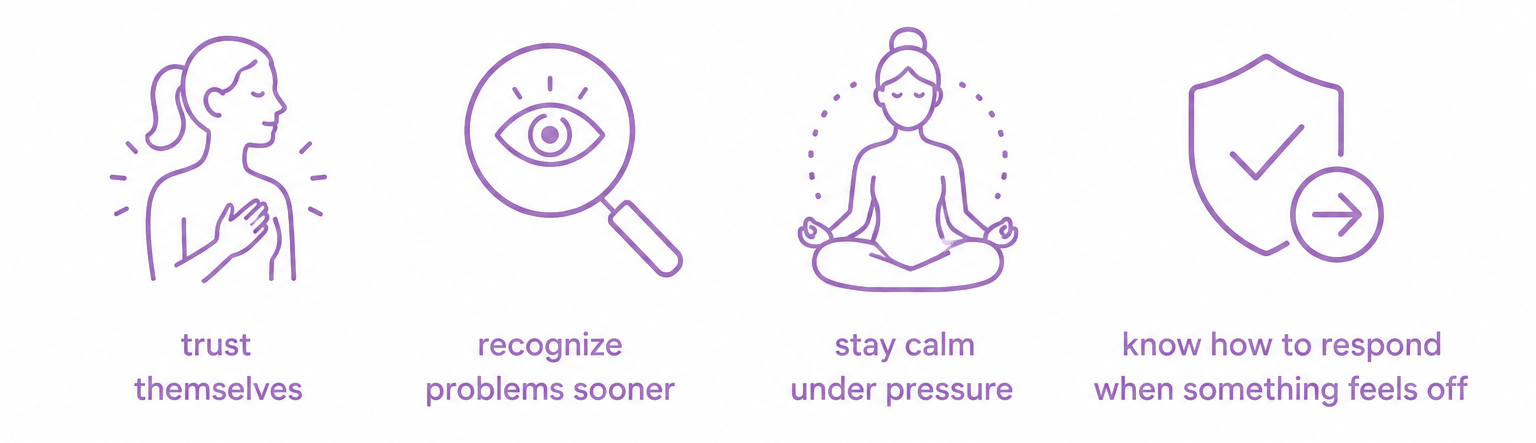
Wendy Jay Training helps women build preparedness in a calm, supportive, and practical way. The focus is not on fear or intimidation. It is on helping women understand how to recognize early signs, trust their instincts, make clear decisions, and stay composed when pressure rises.
This approach supports women who are beginners as well as women who want to refine existing skills. It is especially helpful for women who feel capable in many areas of life but unsure about personal safety, awareness, or fast decision-making.
Training may include concepts such as:
- Situational awareness
- Trusting instincts
- Boundary recognition
- Preparedness mindset
- Emotional composure
- Personal safety education
- Decision-making under stress
- Confidence-building habits
- Real-world readiness
For many women, the most powerful shift is realizing they were never behind. They were simply never taught how to make the first decision under pressure.
Why Local Preparedness Training Matters
Local preparedness training matters because women move through real environments every day. Daily life may include work, errands, appointments, restaurants, gyms, shopping centers, public events, parking garages, travel areas, and home. These everyday transitions are exactly where awareness and decision-making matter.
A woman may need to decide whether to walk to her car now or wait. She may need to decide whether to answer a stranger or keep moving. She may need to decide whether to trust discomfort or dismiss it. Local real-world readiness training helps women apply preparedness to the places they actually go. This makes the training more relevant, easier to remember, and more useful.
Performance, Preparedness, and Pressure
Some women begin with awareness and confidence training. Others eventually want advanced performance under pressure training through pathways such as Sight Shooter. While advanced performance is not always the first step for beginners, it reflects the same larger principle: pressure changes performance.
Whether the skill is using your voice, setting a boundary, moving with intention, or refining advanced training, pressure can expose gaps. The purpose of training is to close those gaps before they matter. Preparedness is a progression. Awareness comes first. Confidence builds next. Performance can be refined over time.
Frequently Asked Questions About Decision-Making Under Pressure
What is decision-making under pressure?
Decision-making under pressure is the ability to choose a clear next step when stress, urgency, uncertainty, or emotion are present. It helps women respond sooner instead of freezing or second-guessing.
How does confidence under pressure help women?
Confidence under pressure helps women trust themselves, create space, set boundaries, and make clear decisions when something feels uncomfortable or uncertain.
What is emotional composure under pressure?
Emotional composure under pressure is the ability to stay calm enough to think, assess, and act when stress rises. It helps women stay connected to their judgment.
What is preparedness psychology?
Preparedness psychology explains how awareness, hesitation, stress response, instinct, and confidence affect the way people respond in difficult moments.
Where can women find confidence under pressure training in Las Vegas?
Women in Las Vegas, Summerlin, Henderson, North Las Vegas, Spring Valley, and throughout Southern Nevada can explore Wendy Jay Training and the training options available.
Start Building Your First Decision Before Pressure Appears
The first decision matters because it shapes what happens next. It can create space, time, clarity, and control. It can help a woman move from hesitation into action.
For women in Las Vegas and throughout Southern Nevada, decision-making under pressure is a practical skill that can be built through awareness, emotional composure under pressure, preparedness education, and real-world practice.
Confidence under pressure helps women build the calm, clarity, and capability to recognize what matters and make stronger first decisions. Whether you are new to preparedness or ready to strengthen your real-world readiness, the first step is learning how to trust yourself before the moment happens. Confidence is built one decision at a time. Start before pressure appears, and give yourself the tools to move through life with greater awareness, composure, and calm capability.
decision-making under pressure: Practical Resources
decision-making under pressure supports calm awareness, practical preparation, and clearer decisions in everyday situations.
Continue building practical skills through our performance under pressure training. For broader planning guidance, explore Ready.gov preparedness resources.